
Science based Palak Paneer
Palak paneer made with the help of science

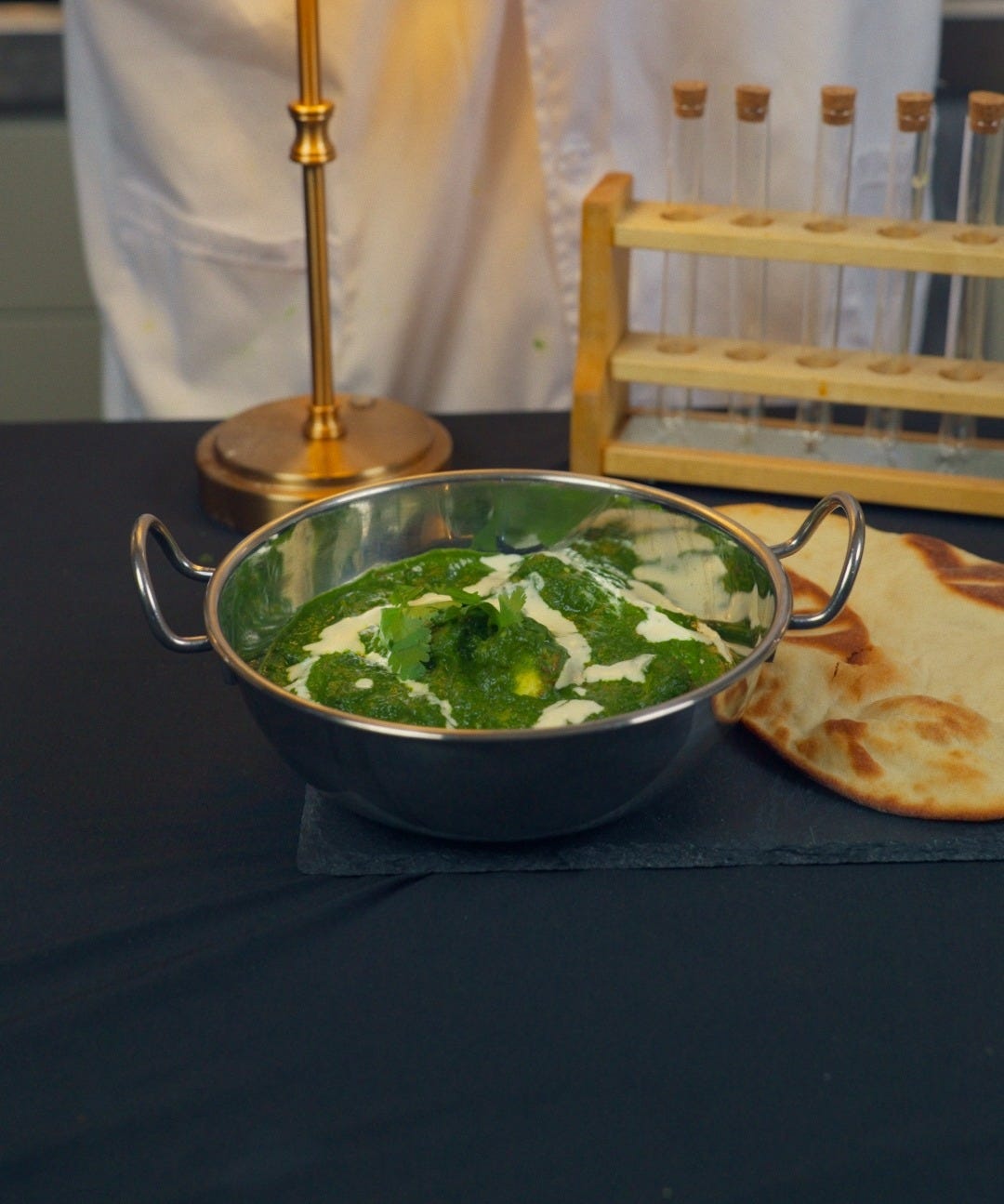
Palak paneer is one of my favourite vegetarian dishes in the world, and for most of my life I had no idea how to make a good one.
I’m writing this from London, where good Indian food is not exactly on every corner, and at some point I got tired of waiting for a restaurant to scratch the itch. So I started making it myself. The problem is that palak paneer is one of those dishes that looks effortless and punishes you quietly. Mine was edible. It was sometimes even nice. But it was almost never the thing I was actually chasing — that deep emerald, almost glowing green, with soft pillows of paneer suspended in a gravy that’s creamy and savoury and tastes of more than one thing.
Mine came out the colour of cooked broccoli. The paneer turned to little rubber erasers the moment it hit the pan. The spinach tasted flat and slightly bitter, the gravy tasted mostly of raw onion, and I genuinely could not tell you why one batch worked and the next one didn’t. I was guessing lool.
The turning point, as with everything else on this Substack, was when I stopped collecting recipes and started reading about what was actually going on. Because once you understand the chemistry, what chlorophyll does under heat, why warm water changes paneer, why the order you add things matters more than the things themselves, palak paneer stops being a gamble. Every step becomes a decision you can defend.
So here’s the version I make now, and the reasoning behind every part of it.
Just like every science-based recipe, I always start by reverse engineering. Before I write a single step I ask: what does the perfect version of this dish actually need to be, and what does each component have to achieve?
For palak paneer, I landed on four objectives.
The colour. It needs to be a vivid, living green — not the grey-khaki sludge that most home versions end up as. This is the thing people notice before they’ve tasted a single bite, and it’s almost entirely a question of chemistry rather than skill.
I achieve this through three interventions that all protect the same molecule. Spinach gets its green from chlorophyll, and chlorophyll is fragile: heat, acid, and the spinach’s own enzymes all conspire to wreck it. So I blanch the leaves for exactly 60 seconds and shock them in ice water, which deactivates the enzymes before they can do real damage; I add a pinch of baking soda to the blanching water to keep things mildly alkaline, because chlorophyll degrades fastest in acidic conditions; and I keep the final simmer short and gentle, because the longer that green sits over heat the more of it turns brown. Get all three right and the colour holds.
The paneer. It needs to be soft, yielding and a little spongy — never squeaky, never rubbery — and it has to taste of the gravy rather than sitting in it like an intruder.
I achieve this by soaking the cubes in warm, lightly salted water before they go anywhere near the pan, and by searing them only briefly. Skip the soak and overcook the sear and you get the rubber-eraser paneer that put me off the dish for years.
The gravy. It needs to be layered and properly built — savoury, faintly sweet, with warmth from the spices — not a one-note green sauce that tastes of raw aromatics. You should struggle to pick out any single ingredient.
I achieve this by treating each element as its own step rather than throwing everything in at once: blooming the cumin in hot fat, sweating the onions until they’re sweet and golden, cooking the ginger and garlic and tomato down properly, and toasting the ground spices for a precise window before they can scorch. Each stage layers flavour the next one builds on.
The texture. It needs to be silky and rounded, with body — not watery, not grainy, and not whipped full of air.
I achieve this with a blended cashew cream that gives the gravy weight without dairy heaviness, a short blend of the spinach so I don’t beat air into it, and a final addition of cream that I never, ever boil.
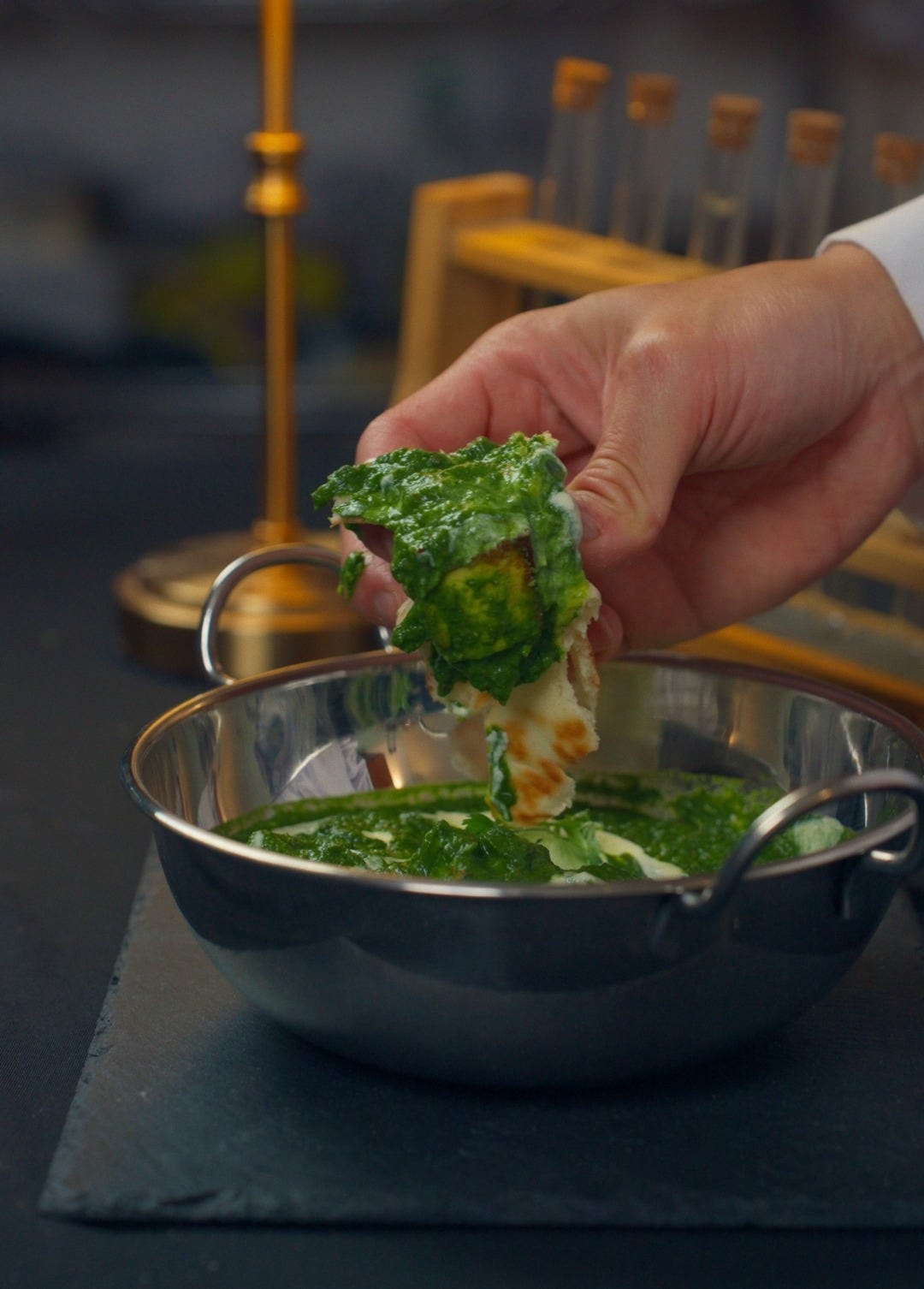
Recipe — with science explanation
Serves 4 — allow about an hour from start to finish
Ingredients
The greens and the cheese
500g fresh spinach, stems removed, washed thoroughly
250g paneer, cut into 2cm cubes
2 green chillies, slit (adjust to taste)
The base
150g yellow onion, finely chopped
100g ripe tomato, finely chopped
3 garlic cloves, minced
2 tsp fresh ginger, minced (about a 1-inch piece)
The cream and body
15g raw cashews
60ml heavy cream (double cream)
The spices
1 tsp cumin seeds
0.3 tsp turmeric powder
1 tsp Kashmiri red chilli powder
1 tsp coriander powder
0.5 tsp garam masala
1 tsp kasuri methi (dried fenugreek leaves)
