
Science based Beef Massaman Curry
Thai-Muslim beef massaman, paste from scratch all explained by science

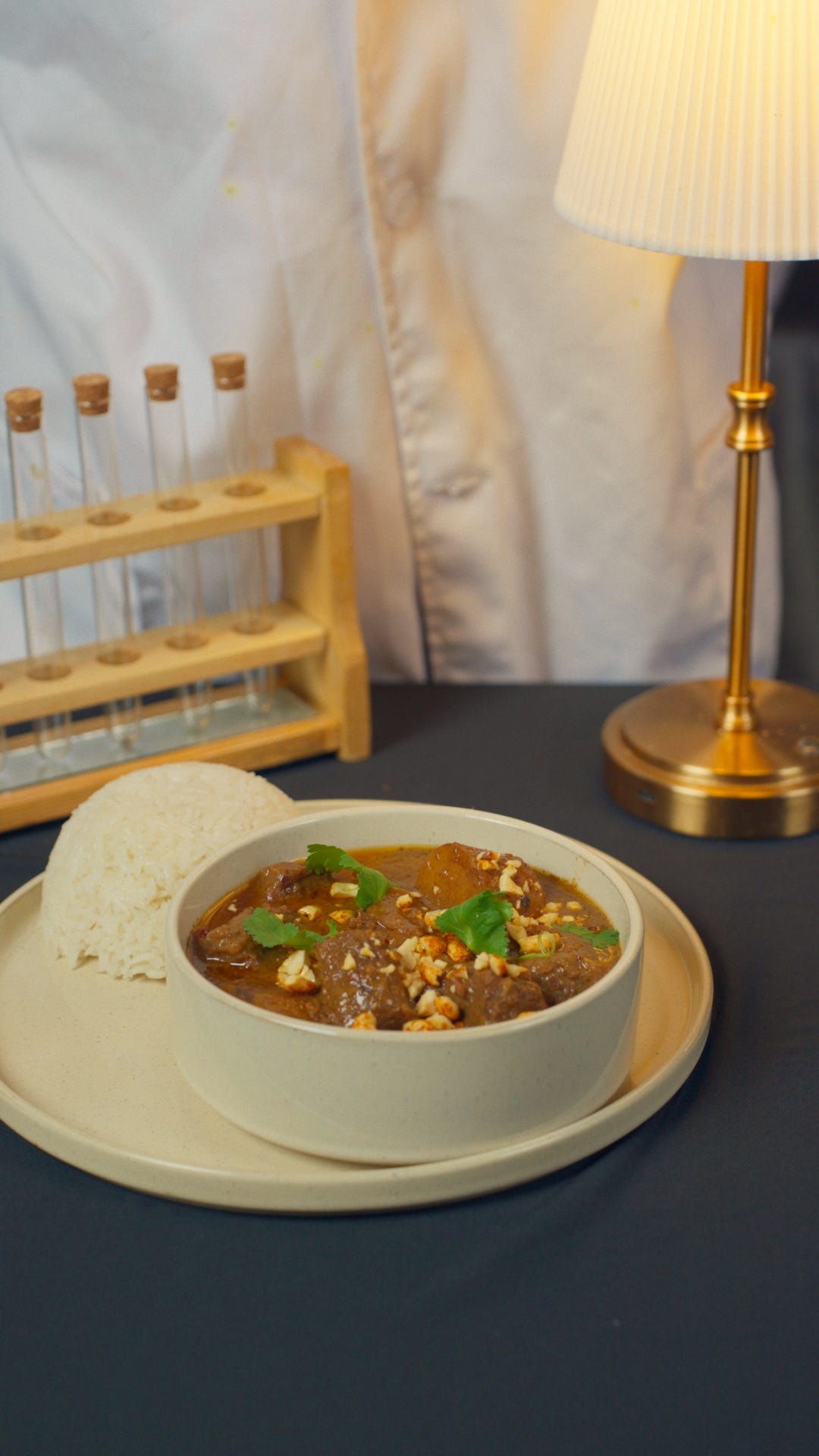
The objectives of perfect massaman
1. A warm-spice paste, toasted and ground from scratch. This is the soul of the dish and the thing that makes a massaman a massaman. The warm spices coriander, cumin, cardamom, cloves, cinnamon, nutmeg, white pepper are massaman’s Persian and Indian inheritance, found in no other Thai curry. Toasting them whole and grinding them fresh wakes up their aroma and gives the paste a depth that pre-ground spice simply can’t. Blend everything smooth and you’ve got the flavour base for the entire pot but it has to be cooked, never used raw, which leads straight to the next point.
2. Cracked coconut cream to fry the paste in. This is the foundational Thai-curry move, and skipping it is why my from-scratch attempts tasted raw. You boil thick coconut cream until it splits and releases its oil ie “cracking” it. Then fry the paste in that oil. Because pure oil gets far hotter than water ever can, it blooms all the spice and aromatic flavours into the fat, cooks out the harsh raw edge of the garlic, shallot and shrimp paste, and adds a little browning. It’s the exact cousin of the bhuna and the pecah minyak I’ve written about before.
3. Chuck braised low and slow. Massaman is a long-cook curry. A gentle two-hour simmer slowly melts the tough connective tissue in the chuck into soft gelatin, which is what makes the beef meltingly tender and gives the sauce its silky body. Gentle is the word because a hard boil toughens the meat and can split the coconut.
4. The balance aka rot chat. Massaman lives or dies on its seasoning, and the target is specific: slightly sweet, gently sour, savoury and mellow, never fiery. Palm sugar, fish sauce and tamarind go in near the end and then get tuned by taste, because the three interact and every brand of tamarind and palm sugar is different heheeheheh.
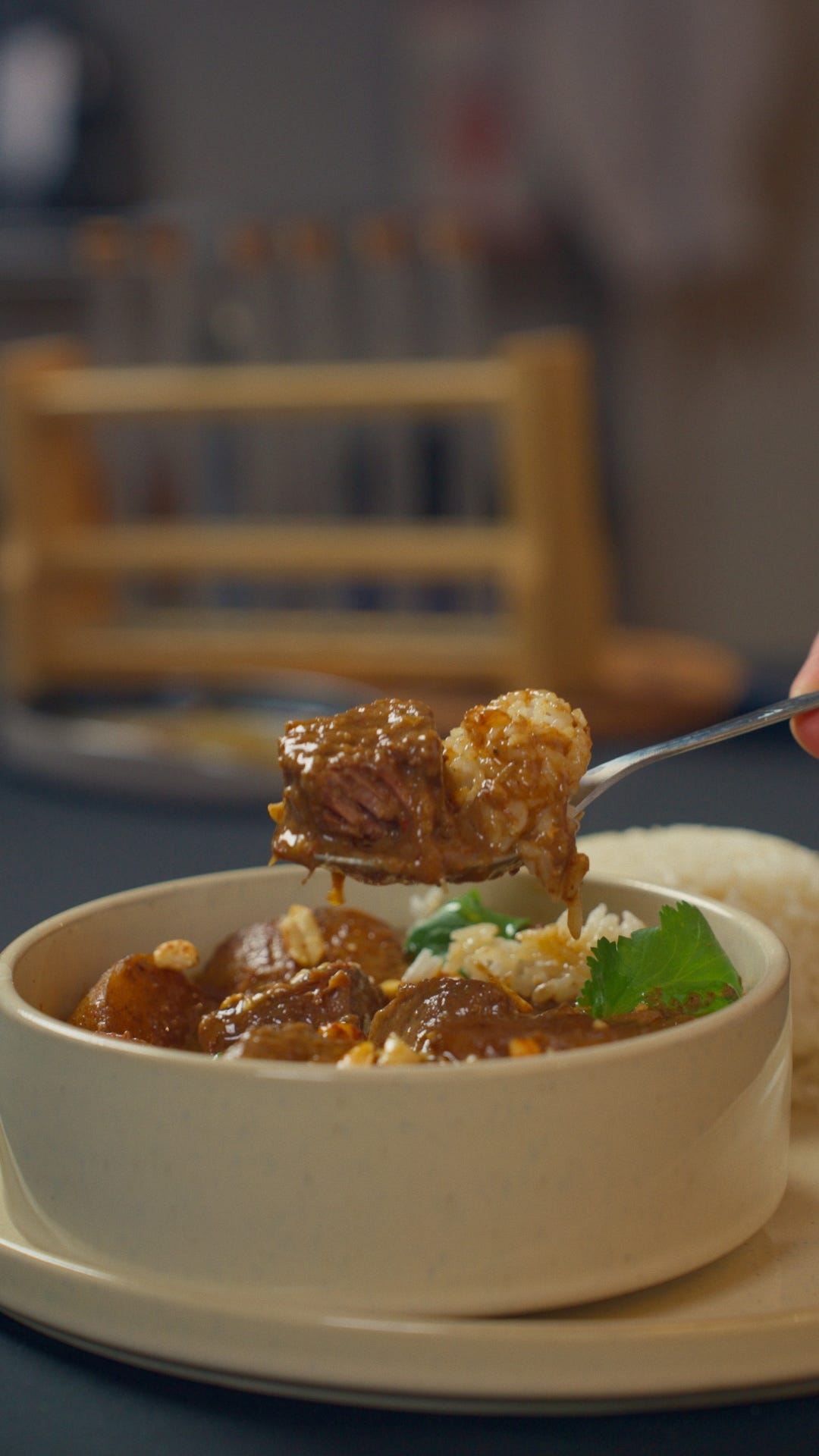
Recipe — with science explanation
Serves 4–6 ( allow about 3 hours, mostly hands-off braising)
Ingredients
The toasted spices
1 tbsp coriander seeds
1.5 tsp cumin seeds
5 green cardamom pods (seeds only)
5 cloves
1 tsp white peppercorns
1 tsp ground cinnamon
0.3 tsp ground nutmeg
The paste
8 mild dried red chillies, soaked and deseeded
6 shallots, peeled
6 garlic cloves, peeled
30g galangal, peeled and chopped
2 lemongrass stalks, white part only, sliced
3 coriander roots (or 6 coriander stems)
2 tsp shrimp paste (gapi)
1 tsp fine sea salt
The braise
800g beef chuck, cut into 4cm chunks
200ml coconut cream (thick, for cracking)
600ml coconut milk (for braising)
300ml water or beef stock
1 tbsp neutral oil
1 cinnamon stick
2 star anise
3 green cardamom pods, bruised
2 bay leaves
The body and the balance
400g waxy potatoes, in 4cm chunks
1 large onion, cut into wedges
80g roasted unsalted peanuts
3 tbsp fish sauce, plus more to taste
2 tbsp palm sugar, chopped, plus more to taste
2 tbsp tamarind paste, plus more to taste
To garnish and serve
1 tbsp roasted peanuts, crushed
1 fresh coriander sprig
Jasmine rice
Method — with science explanations
Step 1: Soak the dried chillies
Soak the 8 dried red chillies in just-boiled water for 15–20 minutes, until soft, then drain. Deseed them first if you want it milder.

The science: Same idea as the rendang. Dried chillies bring a deep red colour and a rounder, raisiny warmth, but their leathery skins need rehydrating so they blend smooth instead of leaving gritty flecks. In massaman the chillies are deliberately mild so they’re here for colour and body, not fire, since this is a gentle curry
Step 2: Toast and grind the warm spices
In a dry pan over medium-low heat, toast the 1 tbsp coriander seeds, 1.5 tsp cumin seeds, 5 cardamom pods’ seeds, 5 cloves and 1 tsp white peppercorns for 2–3 minutes, shaking constantly, until fragrant and just smoking. Cool slightly, then grind to a fine powder with the 1 tsp cinnamon and 0.3 tsp nutmeg.


The science: This is the step that makes massaman taste like massaman. Those warm spices are its Persian, Indian and Malay heritage and the ones that set it apart from every other Thai curry. Toasting dries them out and wakes up their aromatic oils, intensifying and rounding the smell, and grinding them fresh straight afterwards matters because those oils fade within weeks once a spice is ground. Freshly toasted and ground is dramatically more fragrant than anything from a jar.
Step 3: Make the massaman paste
Blend the drained chillies, the ground spice mix, the 6 shallots, 6 garlic cloves, 30g galangal, 2 lemongrass stalks, 3 coriander roots, 2 tsp shrimp paste and 1 tsp salt into a smooth paste, adding a tablespoon or two of the chilli soaking water only as needed to get the blades moving.


The science: Blending bursts open the cells of every aromatic and creates a smooth, even paste that will fry uniformly in the next step. Two ingredients punch above their weight here. Coriander root the traditional Thai choice is far more intense than the leaf and gives an earthy, herbal backbone. And shrimp paste is fermented shrimp: a concentrated hit of savoury, umami depth that sits under everything else. Use galangal, not ginger because its sharp, piney, citrussy note is a Thai-curry signature ginger can’t fake. And the paste is never used raw; it has to be cooked to bloom, which is the whole point of the next step.
Step 4: Crack the cream and fry the paste
In a heavy pot over medium heat, add the 1 tbsp oil and the 200ml coconut cream. Let it bubble and cook, stirring, for 3–5 minutes, until it thickens and the oil visibly separates it “cracks.” Add the paste and fry, stirring constantly, for 5–8 minutes, until darkened, glossy and intensely fragrant, with oil pooling at the edges.


The science: This is the foundational technique behind nearly every Thai curry. Coconut cream is oil held in suspension by coconut proteins; boil it and those proteins give way, releasing the pure coconut oil — that’s “cracking.” It matters because oil gets far hotter than the boiling-point ceiling of water, and frying the paste in it does three things at once: it blooms all the fat-soluble spice and aromatic flavours into the fat so they spread through the whole dish, it cooks the raw, harsh edge out of the garlic, shallot and shrimp paste, and it adds a little browning for depth. This is massaman’s version of the bhuna in a karahi or the pecah minyak in a rendang. Low-fat coconut milk won’t crack, which is why full-fat is non-negotiable here.
Step 5: Brown the beef in the paste
Add the 800g beef chuck and stir for 4–5 minutes, until every piece is coated in the paste and the surfaces have browned.


The science: Stirring the beef into the just-fried paste coats every surface, gives it a light sear that builds flavour on the meat itself, and gets the paste clinging and starting to work its way in. Because a long braise is coming, you don’t need a separate aggressive sear and browning in the cracked paste does the job and keeps it all in one pot.
Step 6: Braise low and slow
Pour in the 600ml coconut milk and 300ml water or stock, and add the cinnamon stick, 2 star anise, 3 bruised cardamom pods and 2 bay leaves. Bring to a boil, then drop to a gentle simmer. Cook partially covered for 1½–2 hours, stirring occasionally, until the beef is fork-tender. Top up with a splash of water if it reduces too far.


The science: Chuck is full of tough collagen, and a gentle 1½–2 hours simmer slowly melts it into soft gelatin, that’s what turns a chewy cut meltingly tender and gives the sauce its silky body. The coconut milk is loosened with water here rather than using more concentrated cream, so it doesn’t over-reduce or split over the long cook, and a gentle simmer rather than a hard boil protects both the beef and the coconut. The whole spices go in on top of the ground ones in the paste because they do a different job: the ground spices give the deep base notes, while the whole spices steeping in the liquid release fresher, higher top notes slowly across the braise.
Step 7: Add the potatoes, onion, peanuts and seasoning
Add the 400g waxy potatoes, the onion wedges and the 80g peanuts, then stir in the 3 tbsp fish sauce, 2 tbsp palm sugar and 2 tbsp tamarind paste. Simmer uncovered for 20–25 minutes, until the potatoes are fork-tender and the sauce has thickened to coat.


The science: The potatoes go in late because they’d disintegrate over a two-hour braise. Waxy ones are specified on purpose because they’re lower in starch and hold their shape, so they soak up the curry rather than dissolving into it, while the little starch they do release lightly thickens the sauce. The peanuts soften slightly and add nutty richness and body. And the seasoning waits until now because tamarind’s bright sourness and fish sauce’s delicate aromas would cook away over a long simmer and adding them near the end keeps them fresh, while the palm sugar brings caramel depth and rounds off the chilli heat.
Step 8: Balance the flavours aka rot chat
Taste, and balance: it should be slightly sweet, gently sour and savoury. Add more palm sugar for sweetness, fish sauce for salt, or tamarind for sourness, a little at a time, until it sings. Discard the cinnamon stick, star anise and bay leaves.
The science: Thai cooking is built on deliberately balancing sweet, salty and sour, and massaman’s target is specific so you want a slightly sweet with a subtle sour note, savoury and mellow rather than sharp. This has to be done by taste at the end because the three seasonings play off each other: sugar mutes acidity and salt, salt makes sweetness read louder, acid lifts and brightens the whole thing. On top of that, tamarind, palm sugar and fish sauce all vary by brand. You’re tuning a system, not following fixed numbers which is why you go a little at a time until it lands.
Step 9: Rest, garnish and serve
Let the curry rest off the heat for 10 minutes so the flavours settle and the sauce finishes thickening. Garnish with the crushed peanuts and coriander sprig, and serve with jasmine rice.


The science: A short rest lets the sauce thicken as it cools slightly and lets the fat and flavours spread evenly through the dish. And like the rendang, massaman is famous for being even better the next day. The warm spices keep infusing and the sweet-salty-sour elements meld and round out as it sits. The crushed peanuts add crunch and the coriander a fresh top note against all that deep, slow-built spice.
The things that actually make the difference
If you’ve read this far you already know them, but here they are plainly, because they’re the ones worth internalising.
Toast and grind the warm spices fresh. This is the heart of massaman its Persian-Indian-Malay spice signature. Toasting wakes the oils up and fresh grinding keeps them, and the difference over pre-ground is night and day.
Crack the cream, then fry the paste. Boil the thick coconut cream until the oil splits out, then fry the paste in it. That oil gets hotter than water can, which is what blooms the spices and cooks the rawness out. Skip it and the paste tastes raw and harsh, exactly the mistake I kept making.
Gentle braise, late potatoes. Keep it at a soft simmer so the chuck turns tender and the coconut doesn’t split, and add the waxy potatoes only for the last 20–25 minutes so they hold their shape instead of dissolving.
Balance by taste at the end. Rot chat is its own step, not an afterthought. Add the palm sugar, fish sauce and tamarind near the finish and tune them a little at a time until it’s slightly sweet, gently sour and savoury.
One last thing: a glossy slick of orange oil on top near the end isn’t a mistake, it’s the cracked coconut oil carrying all that bloomed spice flavour, and it’s a sign you did the cracking and frying right. And like every slow spice dish in this series, massaman is better tomorrow. Make it ahead if you can.
Recipe without explanation
Serves 4–6 — allow about 3 hours, mostly hands-off braising
Ingredients
The toasted spices
1 tbsp coriander seeds
1.5 tsp cumin seeds
5 green cardamom pods (seeds only)
5 cloves
1 tsp white peppercorns
1 tsp ground cinnamon
0.3 tsp ground nutmeg
The paste
8 mild dried red chillies, soaked and deseeded
6 shallots, peeled
6 garlic cloves, peeled
30g galangal, peeled and chopped
2 lemongrass stalks, white part only, sliced
3 coriander roots (or 6 coriander stems)
2 tsp shrimp paste (gapi)
1 tsp fine sea salt
The braise
800g beef chuck, cut into 4cm chunks
200ml coconut cream (thick, for cracking)
600ml coconut milk (for braising)
300ml water or beef stock
1 tbsp neutral oil
1 cinnamon stick
2 star anise
3 green cardamom pods, bruised
2 bay leaves
The body and the balance
400g waxy potatoes, in 4cm chunks
1 large onion, cut into wedges
80g roasted unsalted peanuts
3 tbsp fish sauce, plus more to taste
2 tbsp palm sugar, chopped, plus more to taste
2 tbsp tamarind paste, plus more to taste
To garnish and serve
1 tbsp roasted peanuts, crushed
1 fresh coriander sprig
Jasmine rice
Method
Step 1: Soak the dried chillies
Soak the 8 dried red chillies in just-boiled water for 15–20 minutes, until soft, then drain. Deseed them first if you want it milder.
Step 2: Toast and grind the warm spices
In a dry pan over medium-low heat, toast the 1 tbsp coriander seeds, 1.5 tsp cumin seeds, 5 cardamom pods’ seeds, 5 cloves and 1 tsp white peppercorns for 2–3 minutes, shaking constantly, until fragrant and just smoking. Cool slightly, then grind to a fine powder with the 1 tsp cinnamon and 0.3 tsp nutmeg.
Step 3: Make the massaman paste
Blend the drained chillies, the ground spice mix, the 6 shallots, 6 garlic cloves, 30g galangal, 2 lemongrass stalks, 3 coriander roots, 2 tsp shrimp paste and 1 tsp salt into a smooth paste, adding a tablespoon or two of the chilli soaking water only as needed to get the blades moving.
Step 4: Crack the cream and fry the paste
In a heavy pot over medium heat, add the 1 tbsp oil and the 200ml coconut cream. Let it bubble and cook, stirring, for 3–5 minutes, until it thickens and the oil visibly separates it “cracks.” Add the paste and fry, stirring constantly, for 5–8 minutes, until darkened, glossy and intensely fragrant, with oil pooling at the edges.
Step 5: Brown the beef in the paste
Add the 800g beef chuck and stir for 4–5 minutes, until every piece is coated in the paste and the surfaces have browned.
Step 6: Braise low and slow
Pour in the 600ml coconut milk and 300ml water or stock, and add the cinnamon stick, 2 star anise, 3 bruised cardamom pods and 2 bay leaves. Bring to a boil, then drop to a gentle simmer. Cook partially covered for 1½–2 hours, stirring occasionally, until the beef is fork-tender. Top up with a splash of water if it reduces too far.
Step 7: Add the potatoes, onion, peanuts and seasoning
Add the 400g waxy potatoes, the onion wedges and the 80g peanuts, then stir in the 3 tbsp fish sauce, 2 tbsp palm sugar and 2 tbsp tamarind paste. Simmer uncovered for 20–25 minutes, until the potatoes are fork-tender and the sauce has thickened to coat.
Step 8: Balance the flavours aka rot chat
Taste, and balance: it should be slightly sweet, gently sour and savoury. Add more palm sugar for sweetness, fish sauce for salt, or tamarind for sourness, a little at a time, until it sings. Discard the cinnamon stick, star anise and bay leaves.
Step 9: Rest, garnish and serve
Let the curry rest off the heat for 10 minutes so the flavours settle and the sauce finishes thickening. Garnish with the crushed peanuts and coriander sprig, and serve with jasmine rice.