
Horchata - Mark 16:1-8
A drink inspired by Mary's spices - Mark 16:1-2

Scripture: Mark 16:1-8
‘1When the Sabbath was over, Mary Magdalene, Mary the mother of James, and Salome bought spices so that they might go to anoint Jesus’ body. 2Very early on the first day of the week, just after sunrise, they were on their way to the tomb 3and they asked each other, “Who will roll the stone away from the entrance of the tomb?” 4But when they looked up, they saw that the stone, which was very large, had been rolled away. 5As they entered the tomb, they saw a young man dressed in a white robe sitting on the right side, and they were alarmed. 6“Don’t be alarmed,” he said. “You are looking for Jesus the Nazarene, who was crucified. He has risen! He is not here. See the place where they laid him. 7But go, tell his disciples and Peter, ‘He is going ahead of you into Galilee. There you will see him, just as he told you.’ ” 8Trembling and bewildered, the women went out and fled from the tomb. They said nothing to anyone, because they were afraid.
They went in the dark, and they went with purpose. Mark tells this story with a kind of plain, unhurried simplicity that I think is part of why it lands so hard that Mary Magdalene and Mary the mother of James bought spices, rose early, and made their way toward the tomb while the sun was barely beginning to lift, asking each other the only practical question left to ask: “Who will roll away the stone for us?” There’s something about that question that I find deeply human. They weren’t in denial, they weren’t expecting a miracle, they were just two women who loved someone and were walking toward the hardest possible task with the only thing they had left — the willingness to show up and do it.
The spices they carried weren’t symbolic. They were practical, purposeful, and in the ancient world, genuinely expensive. In first-century Jewish burial tradition, aromatic spices — cinnamon, myrrh, aloe — were brought to anoint the body, to honour the dead with fragrance when there was nothing else left to offer. This was grief that still had work to do, love that refused to be inactive even in the face of the irreversible.
And then they arrived and the stone was already moved. Mark doesn’t slow down for the drama of it, doesn’t give you a cinematic pause — the tomb is open, there is a young man in white sitting inside, and he says the most quietly extraordinary sentence in human history: “He is not here. He has risen.” The spices they carried, the ones they’d bought and prepared and brought through the dark — they were no longer needed. The stone they’d been worrying about the whole walk over was already gone. Everything they had brought to that morning turned out to be unnecessary, not because their love was wrong or their preparation was wasted, but because what they were walking toward had already been overtaken by something so much greater than death that death simply wasn’t there anymore.
Why Horchata?
I’ve been sitting with this passage for weeks trying to figure out what dish could carry it, and the answer kept coming back to horchata and the more I thought about it, the more it made sense. The spices the two Marys brought were cinnamon, myrrh, aloe - warm, ancient, fragrant and horchata is built entirely on that register, with cinnamon as its essential backbone, the flavour the whole drink is oriented around. There’s something in that overlap that felt too right to ignore.
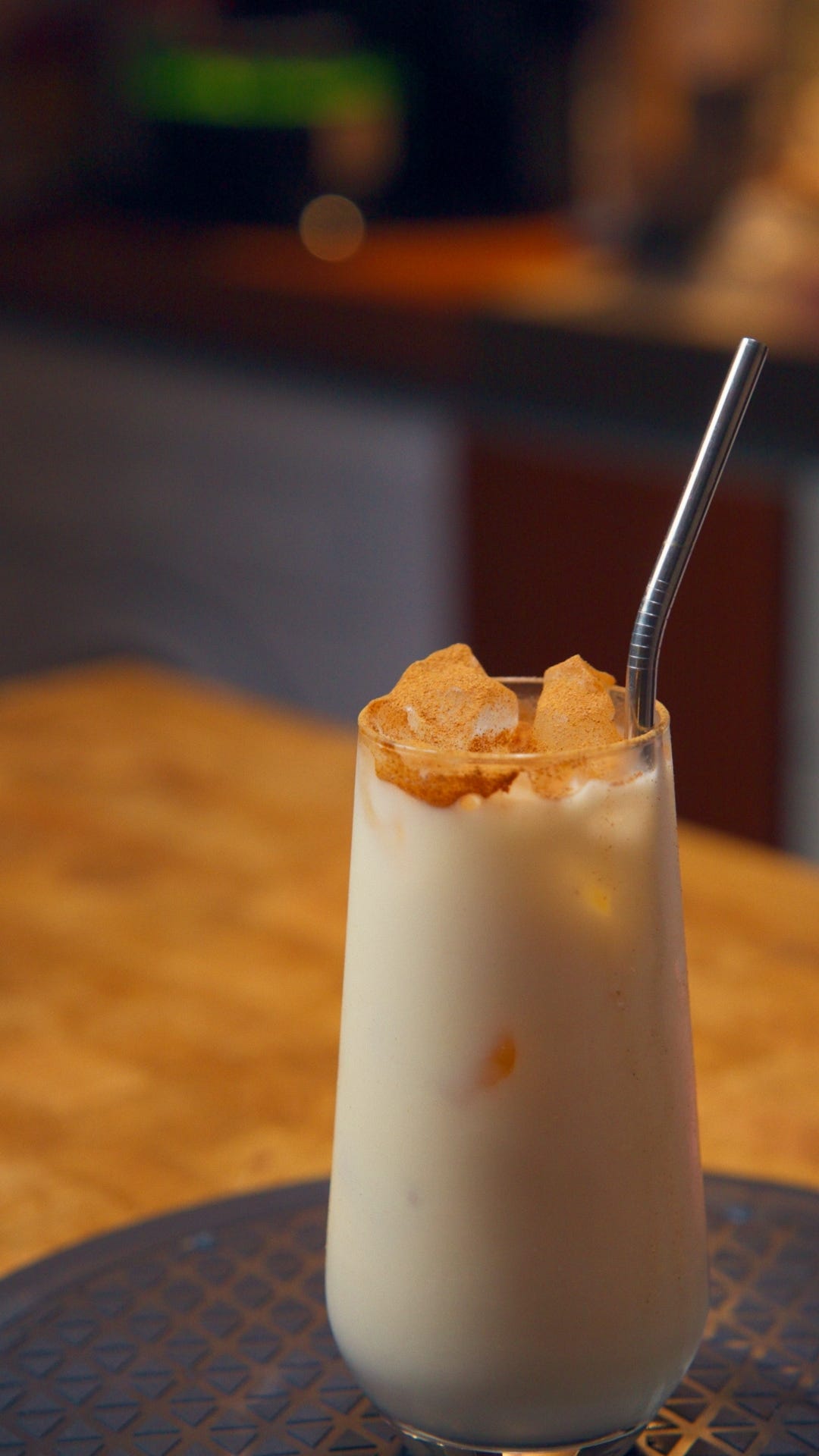
But it’s also white. Strikingly, almost unnervingly white and that matters because white is the colour Mark reaches for to describe the figure in the tomb. “A young man dressed in a white robe.” Some translations render it as dazzling white is the visual signature of this entire passage. It’s the colour of the angel, of the linen burial cloths left folded behind, of the early morning light just catching the horizon as the women approached. Horchata holds that colour in a way that no other drink quite does. it’s not translucent, it’s not pale, it’s genuinely, quietly, startlingly white, and when you pour it over ice on an Easter morning it looks like exactly the thing it’s supposed to represent.
Other Resurrection inspired recipes:
Recipe
Makes approximately 1.5 litres — serves 4 to 6
Ingredients
1 cup long-grain white rice, uncooked
1½ cups blanched almonds
1 cinnamon stick — Mexican canela if you can find it
4 cups filtered water, for soaking
2 cups cold water, for blending
1½–2 cups whole milk or evaporated milk (oat or almond milk works too)
1/2 cup of Condensesd milk
½ cup granulated sugar, to taste
1 tsp pure vanilla extract
A pinch of fine salt
Ground cinnamon and a cinnamon stick to serve
A lot of ice
Method
1. Soak overnight. Combine the rice, almonds, cinnamon stick, and 4 cups of water in a large bowl, cover, and leave for at least 6 hours (overnight is better). Don’t skip this step because this is where all the flavour is developed


2. Blend. Remove the cinnamon stick and blend everything else — rice, almonds, soaking water on full power for 2 to 3 minutes. Longer than it seems like you need but the finer the blend, the silkier the drink.


3. Strain twice. Pour through a cheese cloth over fine-mesh sieve or nut milk bag into a large pitcher. Let it drip through and squeeze out of the cheese cloth. it should be fine enough to not pass through


4. Add everything else and chill. Stir in the cold water, milk, condensed milk, sugar, vanilla, and salt. Taste and adjust. Refrigerate for at least an hour before serving.


5. Store Serve and ENJOY. Store in a large jug or in a glass container and refrigerate for up to a week. To serve pour over a generous amount of ice and dust with ground cinnamon. Add a cinnamon stick if you’re feeling it.


Jesus loves you — and so do I.